-horizontal-(1)_1.jpg)
-horizontal-(1).jpg)
Kettering psych-rockers Temples have never been a band to sit still, but their latest record, Bliss, marks a serious shift in gear.
A Moving Target
Bliss has a lot more momentum and movement than some of your other records. Did you want to surprise people with what Temples can sound like? What was the logic behind that direction?
James Bagshaw: I think we wanted to surprise ourselves, really. It’s funny, you tend not to try and think about people listening to the music when you’re working on it at all, actually. The creative journey is a very selfish experience, or it can be, in a very liberating way. We’re in that fortunate position where we’ve always been on indie labels, and that affords you the freedom to not have external A&R telling you how you should sound and all that sort of rigmarole.
For us, it’s a moving target when you’re recording and writing, until you get the core identity of what the album is. Part of that identity this time was the momentum, the movement, the sort of danceability of a lot of the songs. There’s only really one slower moment on the record, and it just felt weird to have anything more than that. It needed to be a very forward-moving, momentous sort of album.
Was there a specific song where you realised the sound was taking a distinct turn?
James: Yeah. I mean, Jet Stream Heart hits straight in at the deep end from the start; there’s not really any build to it. Later on, it goes a bit more experimental, but that song is probably more what people might expect of us as far as the feeling of the melodies goes. But to answer your question, Vendetta was the real point of like, oh right, okay. It feels weirdly nostalgic and forward-thinking. It sounds like Temples, but it also sounds like it could have been around the millennium, back when the Ibiza club scene was probably at its golden era, as far as those songs that are so synonymous with club culture. I actually had the idea for that song for quite a long time and didn't show anybody because I hadn't figured out the delivery.
The keyboard sound was in my original demo, but it was right at the beginning. Adam came around one day, and I was like, "Look, I've got this idea," and I was slightly embarrassed. I’ve actually learned that feeling that way is a healthy thing now. Being at peace with the fact that they’re either going to hate it or love it is a much better place to be than being safe. After Jet Stream Heart, Vendetta became the yardstick to measure other songs by.
Capturing Melancholic Euphoria
Let's talk about Jet Stream Heart… it really captures that late-night club vibe. How do you go about capturing that kind of energy as a band when you're in the studio?
James: A lot of it is down to sound choices and the production itself, the rhythms of the bass and the pretty straightforward, banging drums. For us, we always want to capture the essence of the band, but to this day, we have never actually sat in a room and recorded a song altogether. We just don’t do it like that. But we wanted to have the feeling of what the live show is going to be before we’ve even decided whether the track is going on the record. I want to create excitement and not have it feel like you're recording on a computer. You can do so much with a computer where you can just do a lazy take and not edit it, and a lot of people edit the sh** out of everything, excuse my French. We still want that raw thing of capturing a band like it's live, even though it’s not.
The phrase ‘melancholic euphoria’ has come up a lot for this record. What kind of feelings or moods kept returning to you while you were writing and creating it?
James: The euphoria comes from two things: the rhythm of the song, which can be incredibly uplifting with building crescendos to a moment of bliss, but also the melody, which is the thing that makes it melancholy. If I think back to those classic Ibiza anthems, there is just something remarkably sad about the melodies in a lot of them. Underworld’s Born Slippy is so dark, but it’s uplifting. Faithless’ Insomnia, Moby... those records are inherently melancholic and uplifting. I don’t think you can really do that in a rock band format without getting the production, the sound choices, and the melodies exactly right. Whatever it is, we’ve captured it on quite a lot of these songs. I firmly believe it. I actually want someone to sample these songs and make them true club tracks. That is my dream. I’d love it if someone like HAAi took Vendetta and turned it into a true club thing, not like a nostalgic ‘this could have been a song then’ vibe.
That makes total sense. There’s such a strong element of escapism connected to that era too… the way it lets people work out their feelings together. On that note, why did Bliss feel like the perfect title to sum up the whole album?
James: Naming an album is one of the hardest things ever; it’s like naming your child, you’ve got to stay with it and be okay with it forever. We’ve done single-word titles a few times with Volcano and Exotico. I guess Bliss was a way of not arrogantly calling it Euphoria. Plus, if we called it that, people would probably think we were talking about the TV show, which I haven’t even seen! Bliss just sums it up. It’s not us saying the album is blissful, but when you land on the right mood of a song, you achieve a kind of creative bliss.
As an artist, you’re always searching for that. And I think people who listen to music get the same experience; there’s a point where the song becomes theirs. They hear the layers, feel the depth, and then it becomes a snapshot of that time. Years from now, they'll look back and remember exactly where they were when they first heard it.
Cooking Up a Song
Did any of the songs completely surprise you during the recording process and turn into something totally different from where they started?
James: Yeah, quite a few. Jaguar was a big one. Tom had a demo of it from before we were even writing for this record. The feel of his original demo had this slight soul thing going on, but it was also a bit like Hall & Oates! It was very different from what it is now. Once we figured out the core identity of the album, we looked at Jaguar again and realized that if we started from the ground up and changed the production, it would become something else.
We used cut-up breakbeats, samples, and did weird shit with Rens’ drums, time-stretching them and treating it more in a Moby sense, or like Massive Attack. I absolutely love that song now and can't wait to play it live. It's mysterious and has great energy. The other one was Waiting on the Echoes, which originally came straight in with fast drums, but what we learned on Vendetta influenced it to become more dreamy and dreary in the right way.
With music that has so many layers and textures, how do you actually know when a song is finished? When does it feel done?
James: I think it’s very hard to explain when something’s finished, because sometimes something isn’t finished until it’s mixed. Like, you truly don’t really know whether you’ve got everything in place.
But I think the best comparison is like, you know, cooking. If a chef is cooking, they know there are 50 ingredients in this, and you can’t really taste 30 of them, so what are they doing in there? I think it’s kind of like that. I mean, obviously, some great dishes do have a hundred ingredients in, like a curry with depth. But equally, Italian food can have three ingredients, tomatoes, salt, and olive oil, and be fantastic, you know. I’d compare it to that.
You just sort of know, and you know whether you’ve over-seasoned something, and you know whether something is a bit bland and a bit beige. You just go with your instinct, and I firmly look back at everything that we’ve ever done from a production point of view and believe that the songs were finished, whether they had less on them or more. Some of the mixes I’d like to revisit in general in our catalog, but not on this record. You just sort of know instinctively.
That might honestly be my favorite metaphor for knowing a song is finished. It completely makes sense.
James: You know what I mean? Yeah!
Staying Independent
Compared to when Temples first started, what excites you the most about making music today?
James: You’re always trying to write something better. For me, it’s entirely from an artistic point of view, not a I want this song to be famous point of view. I just want to create something I can be really proud of. Vendetta is probably my favorite song I’ve ever written, even though it’s only just come out and I don’t know whether people like it yet!
Nick Cave said something the other day in a Kylie Minogue documentary. I’ll probably misquote him, but he was like, "Nobody knowingly wants to be indie." I thought that was very interesting. I love being in an indie band as far as the freedom of making a record goes, but when you tour, it can be very restricting because your creative output is restrained by financial aspects. If we could do exactly what we wanted with our live production, it would be incredible.
So, what excites me? It’s the idea of having a song that really does get out there. If a song resonates with people on a big scale when it comes from such an independent place, it’s the most rewarding thing. You can stand up there and say, "Yeah, I know this is good because the intention behind it was good." We just made it for ourselves, and now it’s this. A committee of 20 people didn’t design it because they know it's going to be a hit.
When I first heard the album, my immediate thought was that I just wanted to hear it live immediately. Since you don't track things traditionally as a live band in the studio, how do you go about reconstructing all these complex layers for the stage? Are there any tracks you're particularly excited to debut?
James: Rehearsals for a new record are always tricky. You’re figuring out who plays what bit, and it gets complicated when I'm trying to play a part and sing at the same time. We just played four Spanish festivals this month over a couple of weekends, so crowds got to hear Jet Stream Heart and Vendetta live. On the first night, in front of a big crowd, I completely forgot what it was like to get on stage and play a song for the very first time. It’s terrifying! You get to the next part of the song, and you literally question whether you know it. But when you start playing them live, they become more bombastic, louder, and more dynamic than what you can actually put onto a record.
Looking ahead, what is next on the horizon for Temples?
James: Well, we’re going on tour this year, and we’re playing some UK stuff. We’re doing Latitude Festival, which is going to be great. We haven’t been back there for many years, and it’s one of the first festivals we ever played, really, so that’s cool. And then we’ve got a UK tour, Europe as well, yeah, all across Europe for like six weeks, and then we have two US tours… we’re in China in August as well for a week.
It sounds like an incredibly busy and exciting time ahead!
James: Yeah, it’s been a while since we’ve done anything quite like that! I mean, we’re on a new label now, and everybody’s sort of just working so hard behind the scenes, they really believe in the record. That’s the thing to take home from all of this.
People, including myself, complain about how much harder it is now with touring, with streaming being the primary way people consume music. But like when you’ve got a team of people that believe in a record, people still do have such a drive to like get behind art, and that’s just really nice. So really thankful for those taking a punt on us!
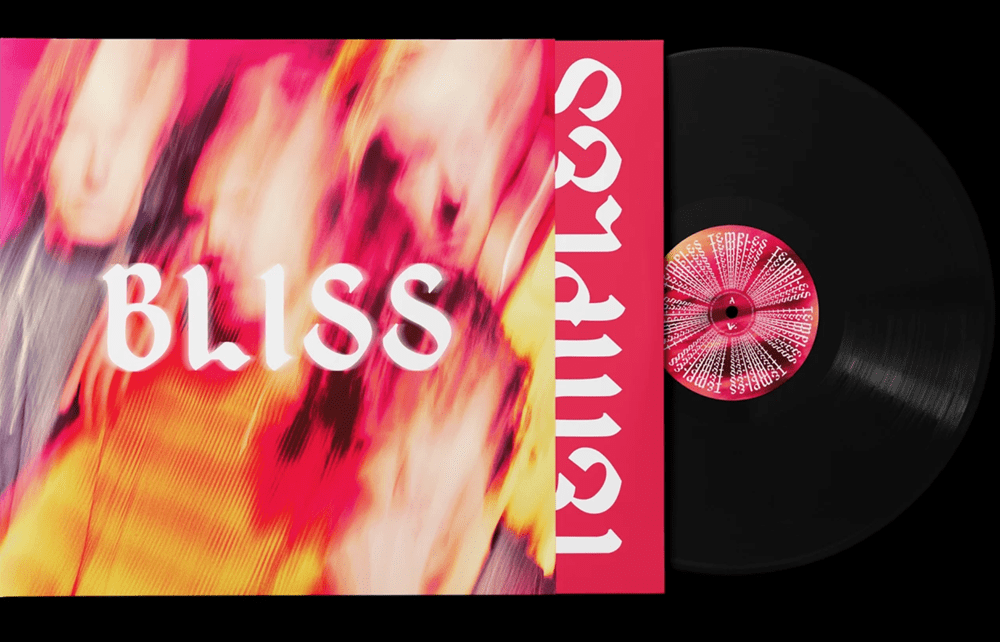
Temples' new album, Bliss, is available to pre-order below. Out June 26th.
SHOP NOW
Photo Credit: Jimmy Fontaine