As Christopher Nolan transports audiences back to the ancient world in The Odyssey, take a seat and dive into our retrospective on the director who continues to push the absolute limits of physical film.
In an era of streaming and shrinking screens, few filmmakers champion the pure, physical scale of the cinema experience quite like Christopher Nolan. While most modern blockbusters lean on predictable plots and weightless CGI, Nolan does things differently. His work is built around one fascinating idea: that reality is entirely in the eye of the beholder. Instead of handing us easy answers, he grabs us by the collar. Combining giant IMAX cameras, dangerous practical stunts, and floor-shaking sound design, he locks us directly inside his character's head. We do not just watch these stories unfold; we are completely consumed by them.
Look closely at his career and you will find characters completely trapped by their own obsessions. He gives us detectives, magicians, scientists, and ordinary parents who desperately try to rewrite their own versions of the truth to survive grief, guilt, or the sheer chaos of the world. They are highly intelligent people who think they can control their environment, only to realise that their grip on reality is incredibly fragile. By anchoring his grand, mind-bending puzzles to these very human vulnerabilities, Nolan ensures that even his biggest spectacles never lose their emotional punch.
The Early Era: Noir Instincts and Gritty Realities
The foundation of Nolan's career was forged in the low-budget world of psychological thrillers, where limited resources forced him to get incredibly creative. He first showed his love for playing with time in Following (1998), a lean British neo-noir shot on weekends that scrambled its story to mirror the psychological collapse of its characters. This ambition exploded into the mainstream with Memento (2000), a brilliant psychological thriller told entirely in reverse. By keeping us in the dark alongside his protagonist, who suffers from short-term memory loss, Nolan turned a clever storytelling gimmick into an unforgettable exploration of grief and self-deception. We are forced to rely entirely on a deeply unreliable narrator, realising along the way that we only see what we want to believe.
With his reputation growing, he transitioned to studio filmmaking with Insomnia (2002), an atmospheric remake that traded narrative puzzles for a tense, character-driven police procedural. The film proved he could handle major Hollywood stars while keeping the focus entirely on how guilt and exhaustion can fracture a person's moral compass. Having proved his steady hand, Nolan took on the monumental task of reviving a legendary comic book icon with Batman Begins (2005). By stripping away the cartoonish style of previous films and grounding Bruce Wayne's trauma in a gritty, real-world setting, he completely redefined the modern superhero origin story and proved that blockbuster cinema could have real psychological weight.
The Mid-Career: Grand Illusions and Cultural Phenomena
This era solidified Nolan as that rare director capable of marrying personal obsession with unprecedented global box office dominance. He brought a fiercely intellectual energy to The Prestige (2006), a period thriller about rival magicians that felt like a love letter to the art of cinema itself. The entire narrative was structured just like a classic three-stage magic trick, relying on spectacular misdirection to keep us guessing until the very last second. This command of tension paved the way for The Dark Knight (2008), a landmark crime epic that transcended the superhero genre entirely. By pitting a fractured society against chaotic nihilism, the film captured the specific cultural anxieties of the decade and set a new standard for modern blockbusters.
Wishing to push his conceptual boundaries even further, Nolan directed Inception (2010), a highly original heist film that took place entirely within the layers of the human subconscious. Relying heavily on practical stunts and massive rotating sets rather than digital animation, he transformed abstract psychological concepts into a thrilling physical experience. The film remains a brilliant example of how he prioritises emotional clarity over clinical comprehension, leaving audiences debating the reality of a spinning top rather than worrying about the minutiae of the dream logic. He then concluded his superhero trilogy with The Dark Knight Rises (2012), a massive, operatic conclusion that brought a sense of finality to a cinematic journey that altered Hollywood forever.
The Epic Scale: Cosmic Depths and Historical Weight
The transition into his next phase saw Nolan expand his canvas to the absolute limits of time and space. Interstellar (2014) combined rigorous theoretical physics with an unabashedly emotional story about survival, using the vast isolation of deep space to highlight the enduring nature of human connection. He followed this with Dunkirk (2017), a visceral World War II epic that stripped away traditional dialogue and political context in favour of pure survival. By weaving together three distinct timelines operating at different speeds, Nolan created a relentless symphony of tension where the sensory experience of the soldiers overrode standard historical documentary storytelling.
He continued his exploration of high-concept action with Tenet (2020), a complex espionage thriller that utilised the concept of inverted time to stage jaw-dropping practical action sequences. It was a dense puzzle box that actively commanded the audience to stop trying to understand it and simply feel the kinetic momentum. His mastery of historical weight peaked with Oppenheimer (2023), a sweeping biographical drama that functioned as a true showman's odyssey. Written entirely in the first person, the film dropped us directly into the fractured, brilliant, and deeply troubled mind of the father of the atomic bomb. By leaning into the raw alchemy of editing and sound, Nolan turned a complex, three-hour historical study into a billion-dollar box office phenomenon, proving that mass audiences are inherently hungry for challenging art that leaves them with troubling questions rather than easy answers.
The Next Frontier: Pushing the Limits of Celluloid
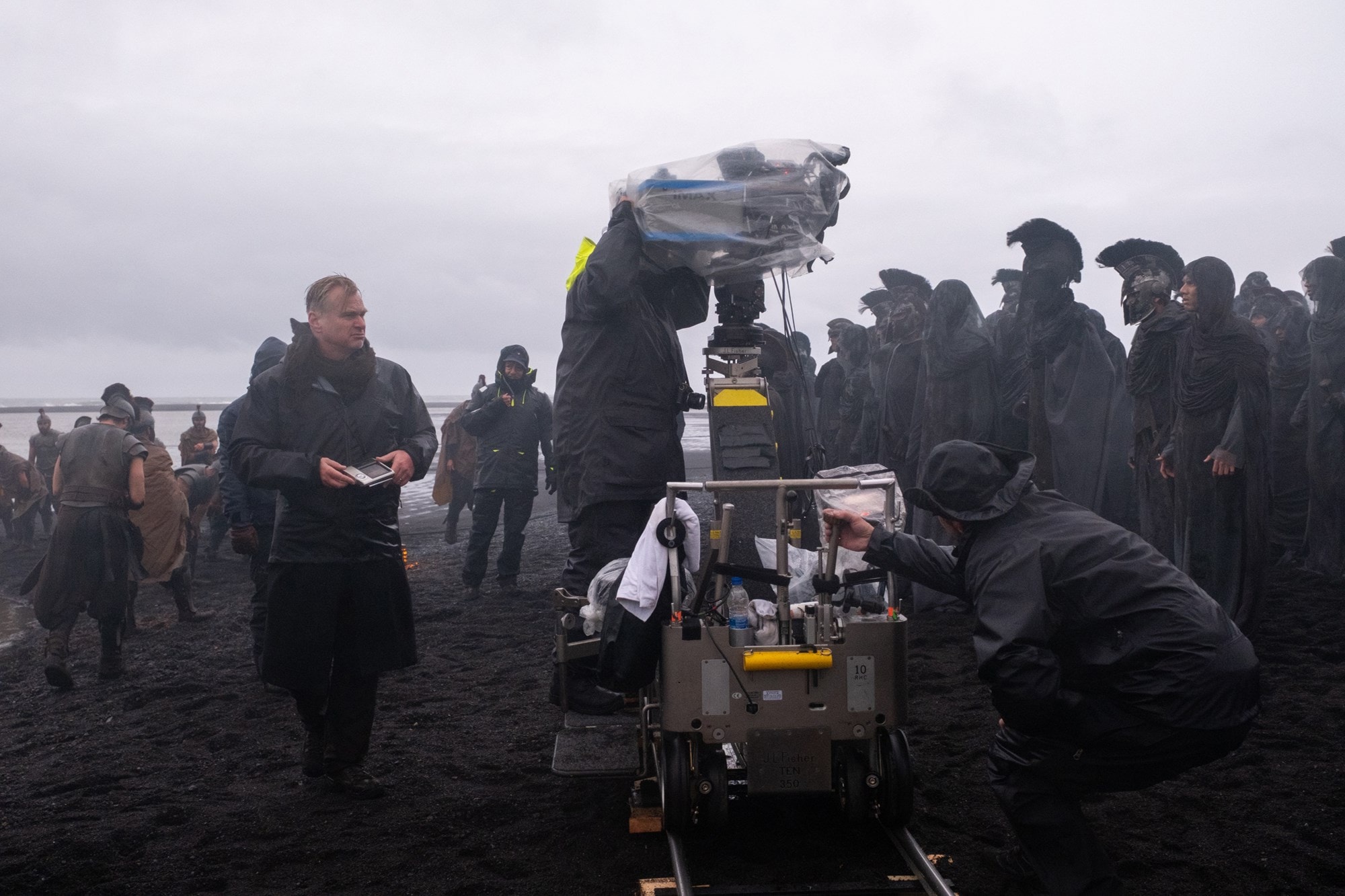
With The Odyssey arriving in UK cinemas this Friday, Nolan appears ready to apply his mastery of perspective to the ancient world, and he is literally pushing the boundaries of physical film to do it. Clocking in at a massive 2 hours and 52 minutes, the film is Nolan’s second-longest epic, sitting just behind Oppenheimer. In fact, Nolan originally envisioned an even longer cut, but was stopped by the laws of physics. A 70mm IMAX film print of that length weighs nearly 600 pounds, and anything longer would physically spill off the giant horizontal steel platters in the projection booth. Instead of compromises, Nolan and editor Jennifer Lame trimmed the fat, delivering a tightly coiled, incredibly dense epic shot entirely on large-format cameras.
This scale is exactly what the legendary text deserves. Where previous Hollywood attempts at Greek mythology have often prioritised weightless CGI spectacles over actual character depth, Nolan is tackling the legendary "main character problem" head-on. By anchoring the mythic battles to a stellar cast, featuring Matt Damon as a weathered Odysseus, Tom Holland as his searching son Telemachus, and Anne Hathaway as Penelope, he is turning an ancient fable into an intimate, high-stakes story about survival and the desperate search for home.
Whether you know the myth from your school days, love the Coen Brothers’ brilliant spin on it in O Brother, Where Art Thou?, or just want to feel the raw power of a 600-pound reel of IMAX film shaking the cinema seats, Nolan is inviting us to experience a classic like never before. The industry’s premier architect of the mind is pushing into uncharted territory, and we are ready to follow him into the storm.